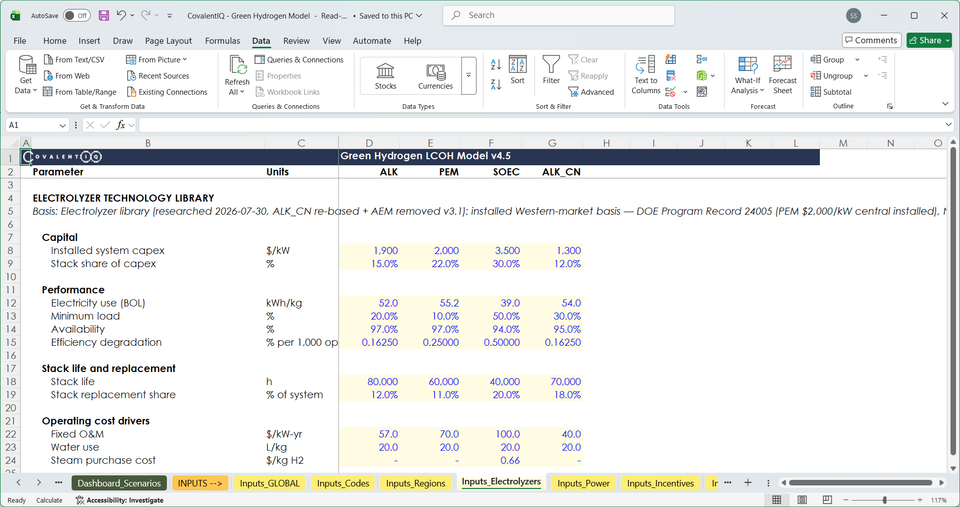
AI makes analytical estimates easier to obtain. For an investment team, the harder task is deciding whether the underlying assumptions support a commercial commitment. A result becomes useful when the team can understand what drives it, check the calculation and test how it changes under different conditions.
At CovalentIQ, we expect Excel to remain a leading tool for corporate financial and economic modeling. A single workbook can bring assumptions, calculations and results together in a form that finance teams can inspect, challenge and adapt. As AI advances, that visibility and control remain essential to sound decisions. Four qualities explain why.
Transparency makes the reasoning visible
Users should be able to trace an output through the calculations to the assumptions and evidence behind it. This helps distinguish a technological advantage from favorable commercial terms or an optimistic operating assumption.
Consider a Texas hybrid scenario in CovalentIQ’s hydrogen model. It buys no electricity, yet capital contributes $6.42/kg to its $8.57/kg gross production cost. The design requires substantial solar, wind and battery storage capacity. Tracing those investments through the calculation reveals what drives the cost of hydrogen and why the investment question extends well beyond the electrolyzer.
Start with equipment costs
The model combines these solar, wind and battery unit costs with the capacity required by the selected design.
Verifiability gives users a practical way to challenge the calculation
Cost components should reconcile to totals, units should remain consistent, and selected calculations should be reproducible independently. Changing an assumption should produce a response that the user can explain.
CovalentIQ’s modeling practices have been refined through demanding commercial and investment projects. Our standards call for traceable inputs, clear calculation steps, consistent units, independent numerical checks and controlled versions. These practices give reviewers a practical basis for testing the logic and assessing whether the model supports the decision.
Adaptability connects the reference case to the actual project
A prepared scenario is a starting point. Users can introduce equipment quotations, power offers, operating constraints and financing terms, then examine their combined effect.
In hydrogen production, a lower equipment quote may be offset by a power arrangement that delivers fewer productive operating hours. Testing both changes within one model makes that interaction visible. Engineering, commercial and finance teams can work through their assumptions on a common basis.
Independent use preserves the value of the work after delivery
Projects evolve as negotiations advance and better information becomes available. A documented workbook allows a capable analyst to revisit the economics, compare alternatives and explain revisions internally.
Keeping the original alongside a working copy allows the team to compare updated assumptions and preserve the basis of the earlier decision. Clear instructions, source records and input conventions help the team continue the analysis and identify where specialist advice would be useful.
CovalentIQ’s models bring together editable assumptions, visible calculations, scenario comparisons and supporting guidance. Your team can examine the economics behind a proposed investment, test its own assumptions and revisit the analysis as commercial terms develop.